
How to Calculate Your Destiny Number: Complete Step-by-Step Guide (2026)

The global astrology and numerology market now exceeds $12 billion, with name-based calculations ranking among the most searched numerological methods worldwide (Gitnux, 2026). Your destiny number — also called the expression number — is one of the four core numbers in your numerology chart. It’s derived from your full birth name, and it reveals the talents, abilities, and life purpose you’re meant to grow into.
But here’s the thing most people get wrong: they either use the wrong name, skip their middle name, or confuse the destiny number with the life path number. This guide walks you through the exact calculation method, step by step, so you get an accurate result on the first try.
You’ll learn how the Pythagorean letter-to-number chart works, see a fully worked example, discover what each destiny number (1–9, plus master numbers 11, 22, and 33) actually means, and avoid the five mistakes that throw off most beginners.
To calculate your destiny number, assign each letter of your full birth name a number (1–9) using the Pythagorean chart, add the digits for each name separately, reduce each to a single digit, then add those together and reduce again. Over 75% of Western numerology practitioners use this Pythagorean method. Use our free destiny number calculator to verify your result instantly.
What Is a Destiny Number in Numerology?
A 2025 survey of numerology practitioners found that the destiny number ranks as the second most frequently calculated core number, right behind the life path number (NumroVani, 2025). Unlike the life path number — which comes from your date of birth and maps the road you’ll walk — the destiny number comes from the letters in your full birth name and reveals who you’re meant to become.
Think of it this way. Your life path number is the journey. Your destiny number is the destination.
In numerological tradition, every letter carries a specific vibrational frequency tied to a number between 1 and 9. When you convert your full name into numbers and reduce them, you get a single digit (or a master number) that reflects your innate gifts, natural strengths, and the opportunities life will keep putting in front of you.
The destiny number goes by several names depending on which tradition you’re reading:
- Expression number — the most common alternative name in Western numerology
- Name number — used in some Vedic and Chaldean traditions
- Namank — the term in Indian numerology systems
Regardless of what you call it, the calculation method stays the same for the Pythagorean system, which is the standard in Western numerology. If you’re curious about how names carry numerical weight beyond the destiny number, our name number calculator breaks down all name-based numbers in one place.
How Do You Calculate Your Destiny Number? (4 Steps)
The Pythagorean numerology system — developed by the Greek philosopher Pythagoras around 570 BCE — assigns each letter of the alphabet a value from 1 to 9 in sequential order. It’s the most widely used system in Western numerology, and it forms the foundation for destiny number calculations used by professional numerologists worldwide.
The Pythagorean Letter-to-Number Chart
Before you start calculating, you need this reference chart. Each letter maps to a number based on its position in the alphabet:
Now, here’s the step-by-step process:
Step 1: Write Out Your Full Birth Name
Use the exact name on your birth certificate. This means your first name, middle name (or names), and last name — spelled exactly as they appear on the official document. Don’t use nicknames, married names, or shortened versions. The birth name carries the original vibrational imprint that numerology reads.
For this example, we’ll calculate the destiny number for: Sarah Jane Miller
Step 2: Convert Each Letter to Its Number
Using the Pythagorean chart above, write the corresponding number beneath each letter:
S  A  R  A  H       J  A  N  E       M  I  L  L  E  R
1  1  9  1  8       1  1  5  5       4  9  3  3  5  9
Step 3: Add the Digits for Each Name Separately
Don’t add everything together at once. Add each name individually first, then reduce each to a single digit:
SARAH: 1 + 1 + 9 + 1 + 8 = 20 → 2 + 0 = 2
JANE:  1 + 1 + 5 + 5 = 12 → 1 + 2 = 3
MILLER: 4 + 9 + 3 + 3 + 5 + 9 = 33 → Keep as 33 (Master Number!)
Important: If any name reduces to 11, 22, or 33, don’t reduce it further. These are master numbers in numerology — they carry amplified energy and special significance. We’ll cover what they mean below.
Step 4: Add the Reduced Numbers and Find Your Destiny Number
2 + 3 + 33 = 38 → 3 + 8 = 11
Since 11 is a master number, we stop here. Sarah Jane Miller’s destiny number is 11 — a master number associated with spiritual insight and intuitive leadership.
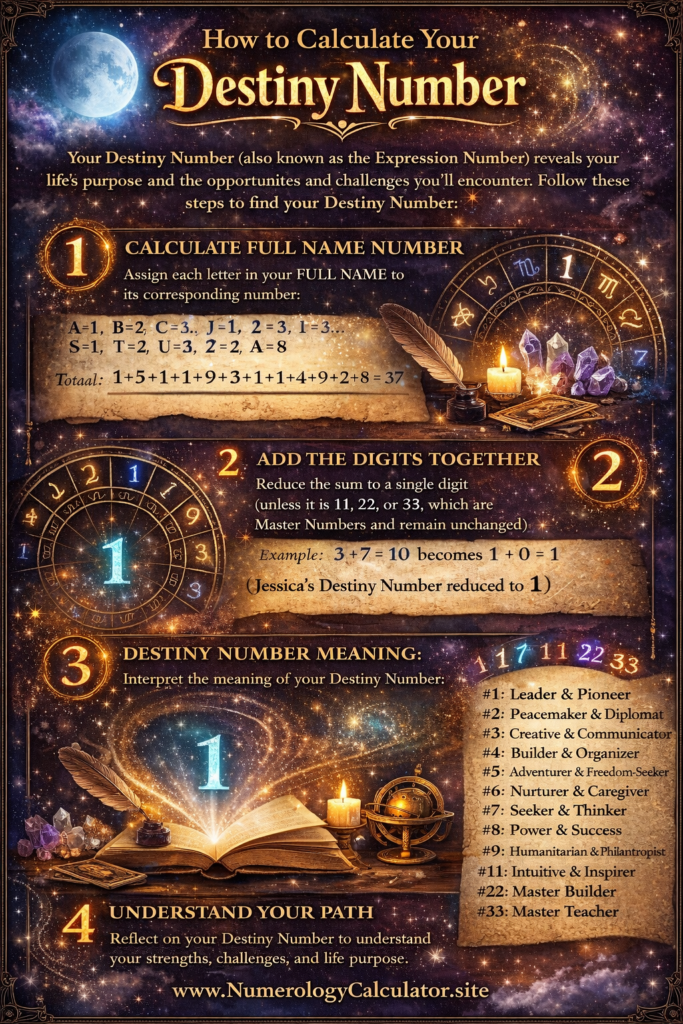
Want to double-check your own calculation? Our free destiny number calculator runs the Pythagorean conversion instantly and shows you the step-by-step breakdown.
Pro tip: The reason you reduce each name separately before combining is accuracy. If you lump all letters together, you risk missing a master number that appears within a single name — exactly what happened with “Miller” producing 33 in our example.
Pythagorean vs. Chaldean: Which System Should You Use?
The numerology industry — projected to be part of a market reaching $9 billion by 2030 (JPLoft, 2025) — primarily uses two calculation systems. The Pythagorean system dominates Western practice, while the Chaldean system has roots in ancient Babylon dating back to roughly 4000 BCE.
Here’s how they differ:
- Pythagorean system: Maps letters A–Z sequentially to numbers 1–9. Uses all nine digits. Most widely taught and used in English-speaking countries.
- Chaldean system: Assigns values based on sound vibration rather than alphabetical order. Only uses numbers 1–8 (9 is considered sacred and excluded). Many practitioners consider it more accurate for name analysis.
For most English-speaking practitioners, the Pythagorean system is the standard. It’s what you’ll find in nearly every numerology book, course, and online calculator. If you’re just getting started, stick with Pythagorean — it’s simpler, more consistent, and makes comparison with others easier.
Our numerology tools support both Pythagorean and Chaldean systems, so you can compare your results across both methods.
What Does Each Destiny Number Mean?
Destiny Number 1 — The Leader
You’re wired for independence and originality. People with this destiny number tend to carve their own path rather than follow someone else’s. You thrive when you’re in charge of a project, business, or creative vision. The challenge? Learning that leadership doesn’t mean doing everything alone — collaboration amplifies your impact.
Destiny Number 2 — The Diplomat
Cooperation, patience, and emotional intelligence define your path. You’re the person who brings opposing sides together, who reads a room before anyone else speaks. Careers in mediation, counseling, teaching, and partnership-based work align with this number. Your growth edge is speaking up for yourself with the same grace you show others.
Destiny Number 3 — The Communicator
Self-expression is your superpower. Whether it’s writing, speaking, art, or performance, you’re meant to create and share. This number carries an infectious, optimistic energy that draws people in. The risk? Scattering your talents across too many projects. Focus is what turns your creative spark into something lasting.
Destiny Number 4 — The Builder
Structure, discipline, and hard work aren’t chores for you — they’re strengths. You build things that last: businesses, systems, families, legacies. Others might see rules as restrictions, but you see them as the framework that makes real freedom possible. Your challenge is flexibility — not every plan survives first contact with reality.
Destiny Number 5 — The Adventurer
Freedom and change fuel you. Routine feels suffocating; variety feels like breathing. Travel, new experiences, and diverse social connections keep you energized. You adapt faster than most, which makes you excellent in dynamic careers — marketing, journalism, entrepreneurship, sales. The trap? Restlessness. Growth comes from finishing what you start, not just from starting something new.
Destiny Number 6 — The Nurturer
Responsibility, family, and service to others sit at the center of your life. You carry a natural desire to heal, protect, and create harmony in your environment. Teaching, healthcare, counseling, interior design, and community work all resonate with this destiny. Watch out for over-giving — you can’t pour from an empty cup, and your needs matter too.
Destiny Number 7 — The Seeker
You’re drawn to depth, analysis, and understanding how things work beneath the surface. Research, spirituality, philosophy, and specialized knowledge call to you. You prefer quality over quantity in relationships and often need solitude to recharge. The growth area? Trusting your intuition alongside your intellect. Not everything worth knowing shows up in data.
Destiny Number 8 — The Powerhouse
Material achievement, authority, and organizational skill define this path. You understand money, power, and how systems work at scale. Business, finance, law, management, and real estate align with your energy. The lesson of this number is balance — success without integrity eventually collapses. Use your power to uplift, not just to accumulate.
Destiny Number 9 — The Humanitarian
Compassion and a broad worldview shape your destiny. You feel connected to causes larger than yourself — social justice, art, healing, or global issues. This number carries both endings and wisdom; you’re meant to let go of what no longer serves and pass along what you’ve learned. Selflessness is your strength, but martyrdom is the pitfall to avoid.
Master Number 11 — The Intuitive
This is the most intuitive of all numbers. You pick up on energies, patterns, and possibilities that others miss entirely. Spiritual leadership, creative inspiration, and visionary thinking define your highest expression. The pressure of a master number is real, though — anxiety and self-doubt often walk alongside heightened sensitivity. Grounding practices help.
Master Number 22 — The Master Builder
Often called the most powerful number in numerology. You have the rare ability to combine big-picture vision with practical execution. Where 11 dreams it, 22 builds it. Architecture, large-scale business, engineering, philanthropy, and systems-level change align with this destiny. The challenge is not shrinking from the weight of your potential.
Master Number 33 — The Master Teacher
The rarest master number. It combines the intuition of 11 and the building power of 22 into a destiny focused on healing, teaching, and uplifting humanity. People with a 33 destiny number often feel a deep calling to serve others — not from obligation, but from genuine compassion. It’s a demanding number that requires emotional maturity to express fully.
What Are the 5 Most Common Mistakes in Destiny Number Calculation?
After reviewing hundreds of manual destiny number calculations submitted through our destiny number calculator, we’ve noticed the same five errors appearing again and again. Here’s what trips people up — and how to avoid each one.
Mistake 1: Using Your Married or Changed Name
Your destiny number must come from the exact name on your birth certificate. If you changed your name after marriage, adopted a stage name, or legally altered your name later in life, that’s a different calculation (sometimes called a “current name number”). The birth name captures the original numerological blueprint.
Mistake 2: Leaving Out Your Middle Name
Every part of your birth name matters. Skipping your middle name — or leaving out a second middle name — changes the calculation. If your birth certificate says “Maria Elena Rodriguez Garcia,” use all four names. Each one contributes to the final digit.
Mistake 3: Not Recognizing Master Numbers
When you reduce 29, you get 11. When you reduce 38, you get 11. When a name totals to 22 or 33, it stays. Too many people reduce master numbers down to 2, 4, or 6 and miss the amplified meaning entirely. Always check: is this 11, 22, or 33? If yes, stop reducing.
Mistake 4: Adding All Letters at Once
The proper method is to add each name separately, reduce each to a single digit (or master number), then combine those reduced numbers. Mixing all letters into one long sum can mask a master number hiding inside a single name — like the “Miller = 33” example we worked through above.
Mistake 5: Confusing Pythagorean and Chaldean Values
If you’re mixing letter values from two different systems, your calculation will be wrong. In the Pythagorean system, the letter S = 1. In the Chaldean system, S = 3. Pick one system and stick with it for the entire calculation.
How Does Your Destiny Number Connect to Your Other Core Numbers?
Your numerology chart doesn’t run on a single number. According to Kenneth Klooster’s analysis of numerological frameworks, the most complete readings combine at least four core numbers to form a full profile (AstroSight, 2024). Think of it as a team — each number plays a different position.
- Life path number (from your birth date) — the road you travel. It shapes your life experiences, opportunities, and major themes. Calculate yours with our life path number calculator.
- Destiny number (from your birth name) — the destination you’re growing into. Your talents, purpose, and what you’re here to achieve.
- Soul urge number (from the vowels in your name) — your inner motivations. What drives you at a deep, private level that you may not show the world.
- Personality number (from the consonants in your name) — your outer persona. The impression you make and how others perceive you.
When your destiny number and life path number are in harmony — say, a 1 destiny with a 1 life path — the energy compounds. Your natural gifts and your life circumstances push you in the same direction. When they differ, it doesn’t mean conflict; it means complexity. You have a wider range of tools to draw from.
Our observation: Users who calculate all four core numbers on our platform report finding the most value in comparing their destiny number against their life path number. The overlap (or contrast) between these two reveals whether your innate skills align naturally with your life’s journey — or whether growth requires stepping outside your comfort zone.
Curious how your name influences compatibility? Our name compatibility calculator compares numerological profiles between partners using these same core numbers.
What Does 2026 Mean for Destiny Numbers? The Universal Year 1 Connection
In numerology, 2026 is a Universal Year 1 (2+0+2+6 = 10, 1+0 = 1), representing new beginnings, fresh starts, and the launching of new cycles. This is significant for every destiny number, but especially for those whose destiny number is 1 — the year’s energy aligns with their core vibration.
For all destiny numbers, a Universal Year 1 invites you to:
- Start something new that aligns with your destiny number’s theme
- Take initiative instead of waiting for permission
- Plant seeds for the 9-year cycle ahead
To see where you personally stand in this cycle, try our personal year calculator — it combines your birth date with the current year to find your individual cycle number.
Your Destiny Number Is Just the Starting Point
Calculating your destiny number takes about two minutes with a pen and paper — or a few seconds with our free destiny number calculator. But the real value comes from understanding what that number means in context: alongside your life path number, soul urge, and personality number.
Here’s what to do next:
- Calculate your destiny number using the destiny number calculator and verify your manual work
- Find your life path number with the life path calculator to see how your journey and destination align
- Explore your full numerology chart using our complete numerology tools suite
- Check compatibility with a partner through the name compatibility calculator
Your name carries numbers. Those numbers carry meaning. Now you know how to read them.
Frequently Asked Questions
Yes. “Destiny number” and “expression number” are two names for the same calculation — both derived from your full birth name using the Pythagorean letter-to-number chart. Different numerology traditions simply use different terms. The calculation method and meaning are identical regardless of which label you see.
Your birth destiny number never changes because it’s tied to the name on your birth certificate. However, if you legally change your name, you create an additional “current name number” that adds a new vibrational layer. Many numerologists analyze both to understand how your evolved identity interacts with your original blueprint.
The life path number is calculated from your date of birth and reflects the journey of your life — your major themes, challenges, and opportunities. The destiny number comes from your full birth name and reveals who you’re meant to become — your innate gifts and life purpose. Think of life path as the road and destiny number as the destination. Use our life path number calculator to compare both.
Master numbers (11, 22, 33) are less common than single-digit destiny numbers, but they aren’t extremely rare. Roughly 1 in 9 names will produce a master number in the calculation process. They carry heightened potential and intensity — not “better” or “worse,” just amplified. If yours is a master number, it means the themes of the base digit (2, 4, or 6) operate at a higher octave.
No. Only use the actual name — first, middle, and last — as it appears on the birth certificate. Generational suffixes like Jr., Sr., II, III, or IV are not part of the numerological name. They’re identifiers, not vibrational components of your birth name.